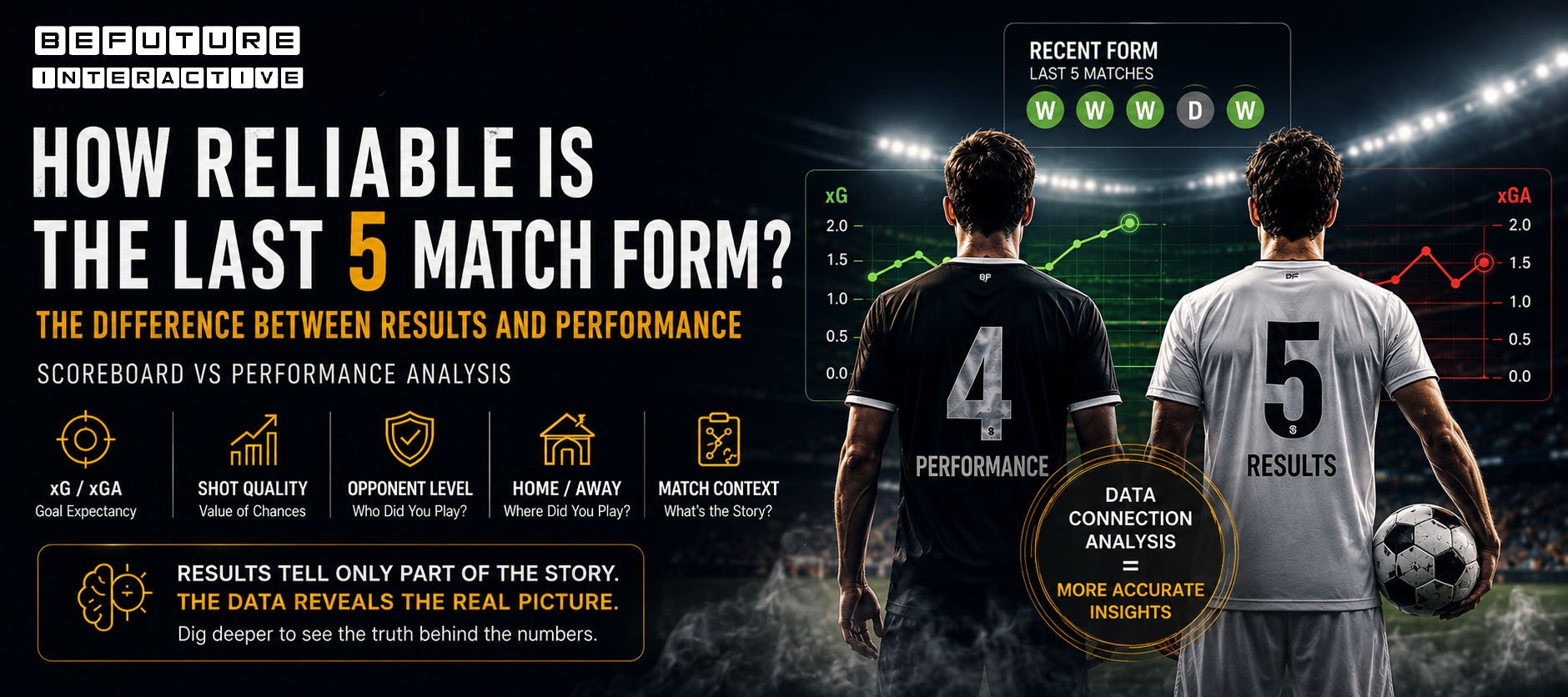



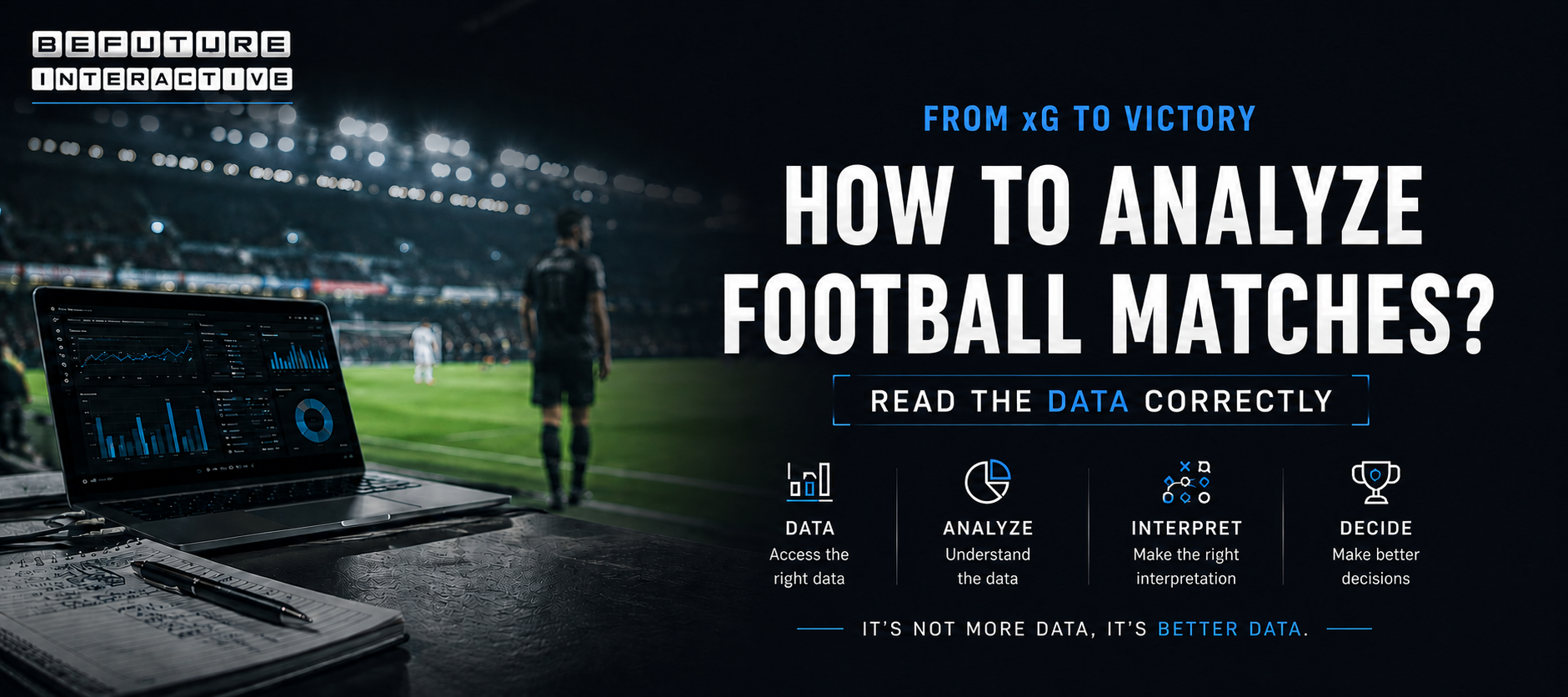
⚽ A team may have won four of its last five matches. Its head-to-head record against the next opponent might look impressive too. But is that really enough to evaluate what could happen next? Football match analysis has far more layers than the final scores and H2H tables suggest.
Why Is Football Match Analysis More Difficult Than It Looks?
When analyzing a football match, the first statistics we check are usually familiar: recent results, league position, goals scored and conceded, home and away performance, previous meetings between the teams, and missing players.
All of these matter. But football is played under constantly changing conditions, which means none of them necessarily tells the whole story on its own.
Form
Shows how recent results have developed, but may not reveal the full quality of the underlying performances.
H2H
Shows the history between two teams, but squads, managers and tactical systems can change significantly over time.
Squad
Injuries, suspensions, rotation and the availability of key players can directly affect the balance of a match.
Advanced Data
Metrics such as xG and xGA can help us understand the performance hidden behind the scoreboard.
For example, an H2H result from six months ago can still be useful information. But since that match, the manager may have changed, the team may have adopted a different tactical system, or important players may have left the club.
The goal is therefore not to dismiss historical data, but to give it the right weight within the current context.
H2H and Recent Form Matter, but They Are Not Enough on Their Own
A team winning four of its last five matches looks like a strong form signal at first glance. Looking only at the results, however, can hide some important details.
- 🎯 Did the team create better-quality scoring chances than its opponents?
- 🧤 Did its opponents fail to convert several high-quality opportunities?
- 🏠 Did most of those positive results come at home?
- 🟥 Were red cards or penalties decisive in those matches?
- 📈 Does the underlying performance look sustainable?
The same principle applies to H2H statistics. Historical meetings tell us what happened between two teams in the past, while current form and squad conditions tell us much more about the circumstances surrounding today's match.
Sometimes the Scoreline Does Not Tell the Whole Story
The scoreline is naturally the most visible outcome in football. From an analytical perspective, however, it can be useful to separate the final result from the underlying performance.
Team A 2-0 Team B
ℹ️ This table is a hypothetical example created to explain the concepts and does not represent a real match.
Looking only at the scoreline, Team A appears to have secured a comfortable victory. The hypothetical underlying data, however, shows that Team B attempted considerably more shots and generated a much higher total xG.
That does not automatically mean “Team B was the better team” or “Team B will win the next match.” What it does tell us is that there may be another layer of performance that the final score alone cannot show.
What Is xG? Understanding Expected Goals in Football
xG (Expected Goals) is an advanced football metric designed to estimate the probability that a scoring opportunity will result in a goal based on comparable historical chances.
Depending on the model and data provider, factors such as the location of the shot, shooting angle, type of attempt, the sequence leading to the chance and other contextual variables may be included in the calculation.
What does that actually mean?
In simplified terms, a chance valued at 0.10 xG means that historically, roughly 10% of comparable attempts have resulted in a goal. It does not mean that this particular shot should or will be scored.
When the xG values of a team's chances are considered together, they can provide an additional perspective on the overall quality of the goalscoring opportunities that team generated during a match.
What Is xGA in Football?
xGA (Expected Goals Against) helps measure the total quality of scoring opportunities that a team allows its opponents to create.
While xG provides an additional perspective on attacking performance, xGA allows us to examine defensive performance from another angle. A team, for example, may concede very few goals across several matches. But if it consistently allows opponents to create high-quality chances, looking only at goals conceded could make that defensive performance appear stronger than the underlying data suggests.
xG
What quality of chances is the team creating? It adds another perspective to attacking performance.
xGA
What quality of chances is the team allowing? It helps provide another perspective on defensive performance.
Why xG Alone Is Not Enough
xG is a powerful tool for football analytics, but treating it as the answer to every question simply creates another analytical mistake.
Football is a relatively low-scoring sport with considerable natural variance. A 0.08 xG attempt can end up in the net, while a much better 0.70 xG opportunity can be missed. Probability does not mean certainty.
More data does not remove uncertainty; it helps us evaluate that uncertainty more intelligently.
xG models can also differ between data providers. The same chance may receive slightly different values depending on the variables and methodology used by each model. For that reason, even xG itself should not be separated from context.
When interpreting xG from a football match, several other factors can matter:
- 🟥 Red cards and the resulting change in match balance
- ⏱️ When the goals were scored
- 🔄 Tactical changes after a team takes the lead or falls behind
- 👤 Missing key players and squad rotation
- 🏆 League, cup or tournament context
- 📅 Fixture congestion and recovery time
What Else Should You Look at When Analyzing a Football Match?
A well-rounded football match analysis should consider whether different layers of information support or challenge one another. At BePrime, the idea is not to depend on one metric, but to evaluate multiple signals whenever relevant data is available.
Performance Data
- Recent team form
- Home and away performance
- Goals scored and conceded
- Match-by-match performance trends
Advanced Football Statistics
- xG and xGA
- Shots and shots on target
- Chance quality and attacking output
- Attacking and defensive trends
Squad & Team Structure
- Injuries and suspensions
- Expected lineups and rotation
- Availability of key players
- Managerial and tactical changes
Match Context
- Head-to-head history
- How the teams' playing styles match up
- Fixture schedule and recovery time
- League, cup and tournament circumstances
Football Data Becomes More Useful When Read Together
The real analytical process begins when we put these different pieces of information next to each other.
For example, winning five matches in a row is clearly a positive signal. But if the same team has consistently generated low xG, allowed opponents to create high-quality chances and relied on unusually efficient finishing to secure those results, the overall picture deserves a closer look.
The opposite can also happen. A team's recent results may look poor even though it continues to create high-quality chances but fails to convert them. Looking only at wins and losses in that situation could hide an important part of its underlying performance.
The point is not to declare one metric more valuable than another. The goal is to understand how different indicators relate to each other.
The Difference Between Football Statistics and Interpretation
Data can show us what happened and help identify certain trends. But football analysis is not simply a matter of arranging numbers in a table.
A team generating high xG can be significant. Yet we should also consider which opponents those chances came against, at what stages of the matches they were created, how the team performed while leading or trailing, and whether its squad or tactical structure changed during the period being analyzed.
Does More Football Data Mean More Accurate Predictions?
No. This distinction matters.
Combining xG, xGA, H2H records, team form, squad information and other football statistics can support a more comprehensive assessment. But no dataset can eliminate the uncertainty that is part of football.
A shot hitting the post, an exceptional goalkeeper save, an early red card, an individual mistake or a single chance in stoppage time can completely change the final result.
The purpose of analysis is not to predict the future with certainty.
The objective is to interpret the available information as accurately as possible and build a more informed and better-supported assessment.
How We Approach Football Match Analysis at BePrime
At BePrime, we do not want a match assessment to stop at questions such as “Did this team win its last match?” or “What does the H2H record look like?”
Recent performance, squad availability, attacking and defensive trends, advanced football statistics and the specific context surrounding the fixture can all contribute to a more complete picture when considered together.
xG is one valuable part of that picture. But it is not a number that makes the decision on its own. The same is true for H2H records, recent form or injury information.
We are not looking for one statistic to provide every answer. We are looking at the complete story the data tells.
Because in football, asking the right questions can be more valuable than simply looking at the final result.
Conclusion: Looking Beyond the Football Scoreline
Football match analysis is not about finding one statistic and using it to reach a conclusion. H2H, recent form, injuries, squad structure, xG, xGA, chance quality and match context are different pieces of the same picture.
Sometimes the final score accurately reflects what happened on the pitch. Sometimes there is a very different story underneath those 90 minutes.
That is why the approach at BePrime is simple: do not stop at the result; try to understand how that result was produced.
Better football analysis does not come from simply seeing more numbers. It comes from reading the right data, in the right context, while asking the right questions. 🎯